Julie
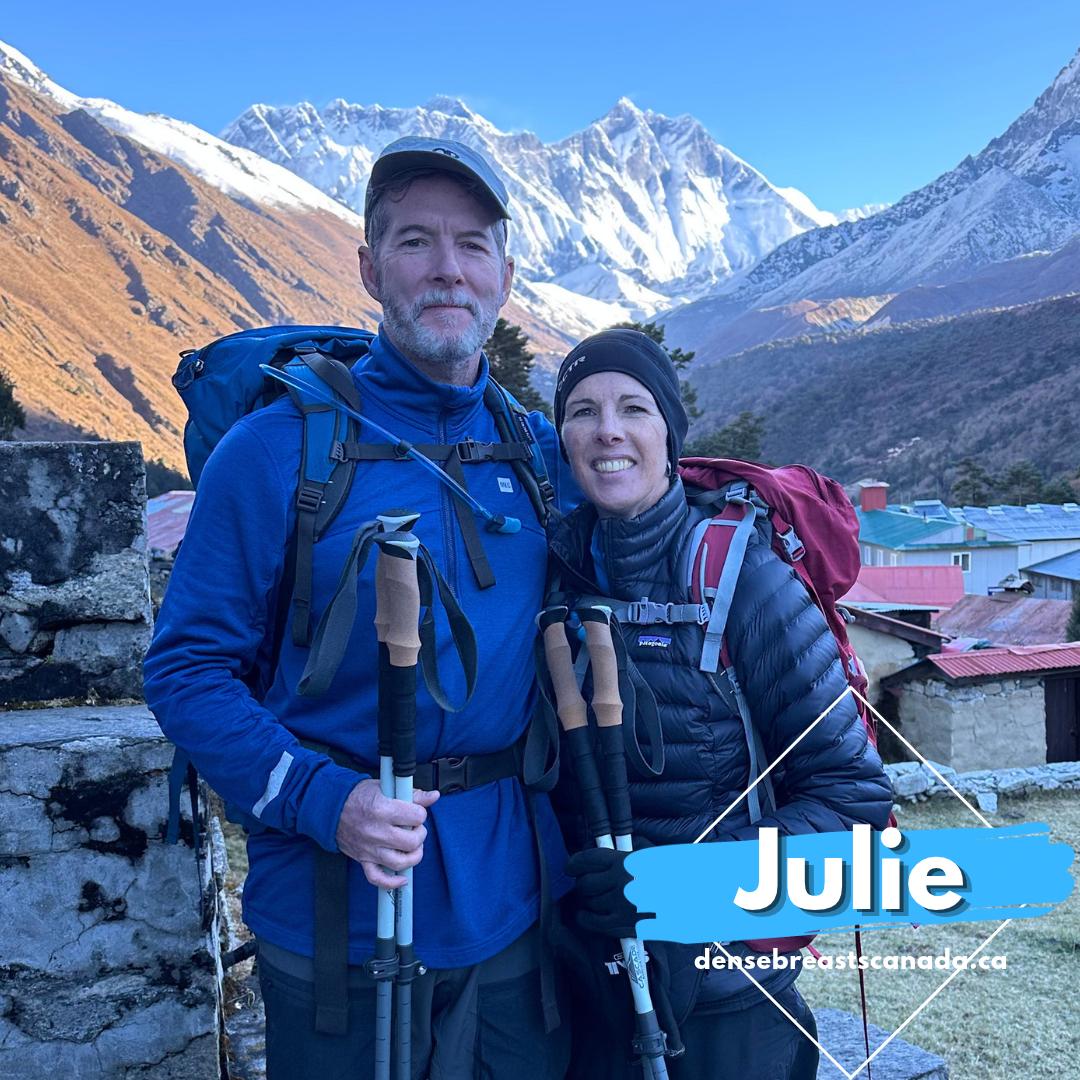
This last year and a half I have climbed two mountains, one literally and one figuratively, and in all honestly the figurative one has been much harder.
In the fall of 2024, my husband and I entertained the idea of trekking to Everest base camp in the Himalayas. As we hadn’t ever done anything like this, we did a ton of research, watched a million YouTube videos, set up a training regimen, picked a guiding company and booked it for the fall of 2025.
In July 2025, I went for my regular mammogram at 53 years of age. I started mammograms at 50, when I thought I was supposed to, went again at 52 where the results recommended I come back the following year due to having ‘dense breasts.’ It was a quick sentence I read, I had no idea what it really meant, had never heard that term before but didn’t think anything more of it because my results were fine. So, that July when I got a call back for a further mammogram and ultrasound I was surprised and a little anxious but quelled it by telling myself I didn’t have a family history of breast cancer, had breast fed all 3 kids, didn’t drink excessively, was at a good weight, exercised regularly and because I was training for our trek I felt I was in the best health I’d been in as an adult. I was sure it would be nothing. I was naïve, and I was wrong.
Microcalcifications were found and a biopsy was required. I was tossed onto the ‘breast mountain’ and I was not prepared. I hadn’t researched, hadn’t watched any YouTube videos, done little training and had no guide. What the hell was I doing? And I didn’t have time to stop and try to figure it out at a pace that made sense, I was already climbing.
My biopsy was August 20 and the result was atypical ductal hyperplasia (ADH), a high-risk lesion of precancerous cells that required removal. The mountain just got higher and the pace quickened. And what about my actual mountain trek? This was not the plan I had envisioned.
I met with a surgeon at the start of September and surgery was booked for September 26. He said that as long as I healed well I was allowed to go on my trek the following month. I kept my fingers crossed. And I started researching, a lot! I found out that ADH has an upgrade rate of 7-53% of actually being ductal carcinoma in situ (DCIS – stage 0 cancer) after it is excised; that ADH puts me at an increased lifetime risk for breast cancer in either breast, especially as it was found before I hit menopause; and that chemoprevention drugs may be helpful and that I should be closely monitored for at least 10-15 years after diagnosis as that is when the risk of developing breast cancer is highest. Not the mountain I thought I’d ever have to climb.
Surgery went well and at my follow up appointment my surgeon’s first question was if I had read my chart (I hadn’t and didn’t even know this was an option; I now have a file with every scan/report I’ve ever had). He said they wanted to send my sample to experts in Toronto as they were unsure if it might actually be DCIS (oh this mountain!). He said I was healing well, to go on my 4-week trek as it would take a few weeks for results and we would discuss when I returned. So that is what I did and had a fantastic time climbing literal mountains (and tried my best to put the results to the back of my mind).
I returned November 12; no results in my chart. I called my surgeon the next week, no results. It was frustrating and scary not knowing if I had breast cancer. At week 9 I asked the surgeon to put in a referral to Oncology so I could at least be on the list if it did come back as cancer; I honestly didn’t know what else to do.
Finally, December 4, after 10 weeks of waiting, my surgeon called to say it was ‘just ADH’, I was ‘good’ and could go back to my regular screenings and I was discharged. That seemed strange to me as I knew the high risks associated with ADH but thought I would ask all of this at my Oncology appointment.
My family Dr. agreed and said I would most likely get a call from Oncology by the new year. The call never came so I reached out mid-January and they said they declined my referral in December and let the surgeon know. I, however, was never told. I asked them what I was supposed to do and who I could talk to about my ‘high risk’ and they said to speak with my family doctor and agreed I should be followed but not by them (which I did understand as I didn’t technically have cancer). I was frustrated so I made an appointment with my family doctor to go over everything and try to come up with some sort of plan as I had learned that not only did ADH put me at higher risk for breast cancer but so did my dense breasts (thank you Dense Breasts Canada for your site and information).
During that appointment I found out, via the expert report which I did not have a copy of at the time, that not only did I have ADH but I also had atypical lobular hyperplasia (ALH) and that post-operative imaging was recommended because I was a ‘borderline case.’ I was never told any of this from the surgeon, nor had I had the recommended imaging done and it had now been 4 months since my lumpectomy. I was angry, frustrated and scared. What had been missed? My doctor advocated for me to be seen by a breast assessment centre near where I live. Luckily, they agreed.
I had a bilateral mammogram done February 9 which found more microcalcifications and required a biopsy done Feb 10. The biopsy came back as benign but required a 6 month follow up, which I had in September and thankfully there’s been no change. In March I had an MRI which found a mass that required an ultrasound. In all the mammograms I had, this was never seen and I wonder if it was missed due to my dense breasts? They believe it to be a fibroadenoma (benign mass) and recommended a 6 month follow up which I had in October and again, thankfully it has not changed in size. Both areas will require on-going monitoring which my doctor and I continue to advocate for.
Over the summer I learned, via research, about the High-Risk Screening Program in Ontario which you are eligible for if you have “a lifetime risk of >25% based on personal and family history via the IBIS (Tyrer-Cuzick) or CanRisk calculator. Through Dense Breasts Canada I learned about the free online IBIS breast cancer risk calculator and found that my risk is 29%. I asked my doctor to put in a requisition even though she said the wait would be long and I may not be accepted because I don’t have a family history. She was right, I just found out last week that I was declined because I don’t have a family history. It’s baffling to me because high risk is high risk. Breast cancer does not care if I have a family history or not, so why does the high-risk program? I have a call into my MPP to look for answers.
In all honesty, it’s been a tough and frustrating 16 months, but I’ve learned a lot. Most importantly, that the mountain is there and at anytime any one of us with breasts can be thrown onto it and expected to start climbing, regardless of family history. As a result, we need to prepare, not panic, but prepare. Learn about the mountain, learn your individual risks (dense breasts, IBIS score) and where you are on the mountain; talk to those who have already climbed and hear the valuable information they have to share (Dense Breasts Canada); set up a training program (mammograms, ultrasound, MRI), and listen to your guide (we all have our internal guide); ask questions if you don’t understand; question the system when it doesn’t make sense and advocate as much as needed.
I know I’m not done climbing but with one step at a time I’m getting there. I just hope that by sharing my story, this trail I’m creating on a mountain I never wanted to climb, can help those that come behind me.
DBC Note: DBC often shares stories from women diagnosed with breast cancer. Julie’s story is different, but just as important. Thank you, Julie, for sharing your experience with ADH and the lessons you’ve learned navigating the healthcare system. We hope your story helps other women better understand their risk and advocate for their breast health.