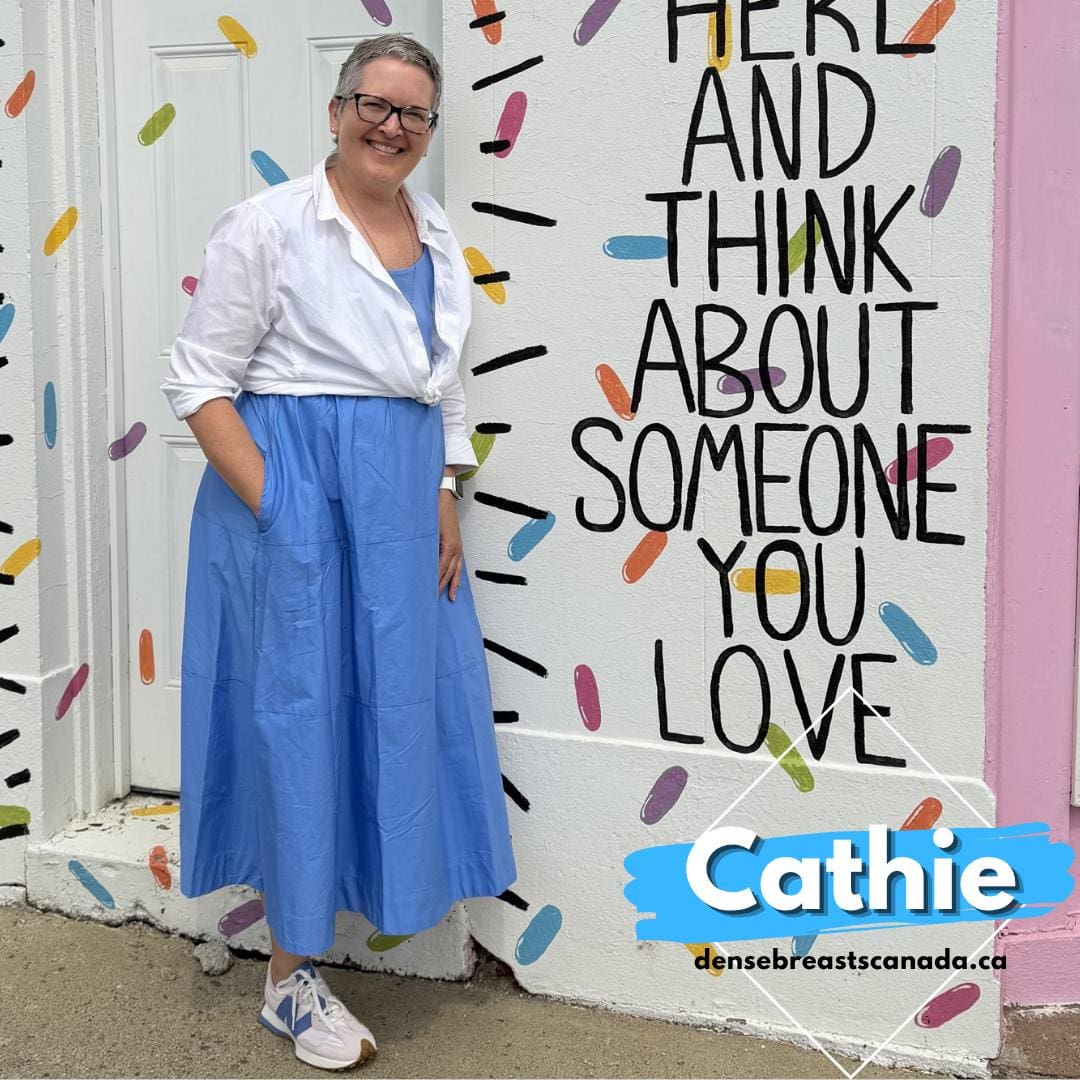
Cathie
Trust Your Body: My Breast Cancer Journey
My name is Cathie.
I am a wife, a mom to two adult children, a bonus mom to three more, and Nana to eight, with one more little grandbaby arriving in November. Family means everything to me, which is why breast cancer has been such a painful and familiar part of our story.
My mom was diagnosed with breast cancer at 45. She had a lumpectomy, followed by chemotherapy and radiation. We are incredibly blessed that she is still here with us.
Then, in 2016, my younger sister Pam—nine years younger than me—was diagnosed at just 36. She had a single mastectomy, followed by chemotherapy and radiation. In 2022, Pam’s breast cancer returned, this time in her bones and the lining of her lungs. We lost her on October 10, 2022. She was only 42.
Pam was a mom to three young boys. Losing her left a void in our family that will never be filled.
Breast cancer was never something I took lightly. I had been having yearly mammograms since I was 35.
On June 2, 2025, I went for my yearly mammogram. I had turned 54 in May. On June 27, I happened to look in the mirror while getting out of the shower. Something looked different. My left breast didn’t look like my right. When I looked more closely, I noticed that the side of my nipple was puckered, and my entire breast felt harder than the other one.
I already had my yearly physical booked for July 7, so I waited until then to talk to my doctor. Deep down, I think I already knew something wasn’t right.
Because I had just had a mammogram, and we didn’t have the results yet, I asked my doctor if he could send me for an ultrasound. He agreed and sent in the requisition. After several phone calls, I was told I couldn’t go directly for an ultrasound. I needed another mammogram first.
On July 30, my sister Pam’s birthday, I went in for two more mammograms and an ultrasound. I was later told they weren’t seeing anything suspicious. But because of my family history, they wanted to do a biopsy the following day.
When I left the biopsy, I was told they were 90% sure it wasn’t breast cancer. I was told it wasn’t presenting like cancer.
But on August 8, we got the news.
It was cancer.
The diagnosis was Grade 1 lobular carcinoma, ER/PR positive and HER2 negative. Later, because of the size of my tumour—11 cm—and lymph node involvement, my diagnosis was changed to Stage 3, Grade 2 breast cancer.
Because of the size of the tumour, a mastectomy was my only option. I knew immediately that I wanted a double mastectomy.
Lobular breast cancer can be difficult to detect on a mammogram, and I knew I didn’t want to continue having mammograms on my remaining breast while always wondering whether the results were truly normal. My surgeon supported my decision.
On October 2, I had a double mastectomy with no reconstruction.
Three lymph nodes were removed during surgery. My surgeon felt that the nodes looked healthy and that he had removed all the cancer.
But there was cancer in all three. That was a real kick to my confidence. If there was cancer in all three lymph nodes, had it spread farther?
Once they found the results of my June 2 mammogram, they compared it with the mammogram from the year before. The scans looked very similar. I couldn’t help but wonder how long had this cancer been growing?
I was scheduled for a CT scan and bone scan to see whether the cancer had spread beyond my lymph nodes. Those days waiting for the results were the most scared I have ever been in my life.
Thankfully, the scans were clear.
I remember walking out of the doctor’s office after getting that news and saying to my husband, “How crazy is it that I’m grateful that it’s only Stage 3 breast cancer?”
And I was.
On December 2, I started my first of eight chemotherapy treatments.
On April 10, I had an axillary lymph node dissection because one lymph node was still showing up on the CT scan. Eleven more nodes were removed, and thankfully, only one contained cancer.
On June 8, I started radiation. I completed 20 treatments, finishing on July 6.
That marked the end of my active treatment, but certainly not the end of this journey.
I will be taking Anastrozole for 5–10 years to block estrogen. I will be taking Verzenio for two years to work alongside the Anastrozole. I will also receive Zoledronic Acid infusions every three months for two years to help strengthen my bones.
Each of these medications comes with its own side effects. But I am grateful for every one of them because they are part of my plan to help prevent this cancer from returning.
I also had private genetic testing done, and the cancer was not genetic.
I am simply one of the women who will develop breast cancer in her lifetime.
But here’s what I want other women to know.
Throughout all those years of mammograms, the density of my breasts was never something that was discussed with me in a way that made me understand how it could affect detection.
My cancer didn’t announce itself with a lump.
I noticed that my breast looked different. I noticed that my nipple was puckered. I noticed that my breast felt harder.
And I listened.
My mammogram was important. My doctor’s appointments were important. The biopsies, scans, surgery, chemotherapy, radiation, and medications have all been important.
But so was looking in the mirror.
So was knowing what was normal for my body.
So was recognizing that something had changed.
Our bodies are amazing. Sometimes they try to warn us that something isn’t right. We just have to slow down long enough to listen.
If something seems off, feels different, or looks different, trust your body. Don’t wait.
You know yourself better than anyone.
I wish with all my heart that my sister Pam was still here to tell her story. I wish she could see her boys growing up, and I wish she could meet all the babies who have joined our family since she left us.
I can’t change what happened to Pam.
I can’t change what happened to me.
But if sharing my story makes one woman pause, check something she has been ignoring, ask another question, or insist on having something investigated because she knows it isn’t right—that would mean everything.
Because early detection can matter.
But so can listening to yourself.
Trust your body. Slow down. Listen. And don’t be afraid to speak up.