
Maureen
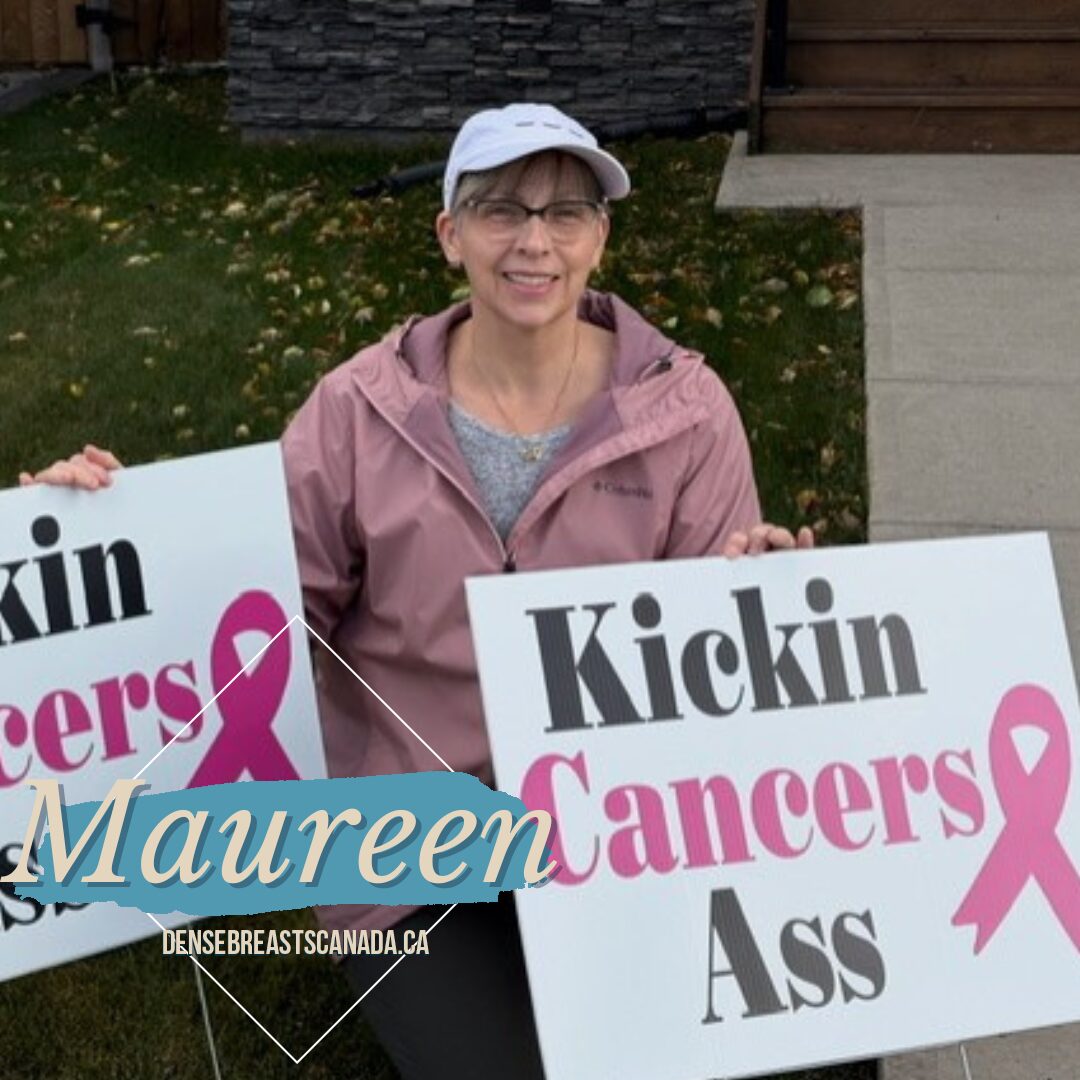
My name is Maureen and I am a retired Canadian Military Police Sergeant. When I was 50 years old, I was diagnosed then treated for Triple Negative invasive ductal carcinoma. I now live permanently in the Edmonton, Alberta area and am a two‑year survivor.
My story begins long before my diagnosis, with one recurring theme: dense, cystic breasts.
I had my first benign lumpectomy at age 14 in Alberta, where I was born and raised. My second lumpectomy happened at age 40 while we were posted in Ottawa. Because both my husband and I served in the military, I moved through different provincial healthcare systems—Alberta, Manitoba, and Ontario. Over the years, I had countless mammograms, ultrasounds, and cyst biopsies because of my very dense breasts.
My genetic testing came back negative, and I have no immediate breast cancer family history with my mother or sister. I do have maternal and fraternal aunt and cousins with breast cancer though. However, I was told that these family members were not immediate enough. It should also be noted that my father had colon cancer.
Despite repeatedly being told I had very dense breasts, I was never offered an MRI in any province. In 2017, I had spinal fusion surgery, which permanently removed MRI as an option for breast cancer screening.
In every province, I was told the same thing: “You have very dense breasts, which slightly increases your risk of breast cancer.” So, I followed the recommended yearly mammograms, with ultrasounds added when determined by the radiologist. But I always wondered: If my mammogram is normal, am I really “good” for a whole year? I eventually learned the hard truth—a normal mammogram does not guarantee safety, especially with dense breasts.
The Timeline
- 25 October 2022 – I had my annual mammogram and ABUS. Results came back “normal,” aside from the usual note about very dense cystic breasts.
- Late January 2023 – I found a new palpable lump.
- Late February 2023 – My GP appointment was cancelled because my doctor was sick.
- 7 March 2023 – After firmly advocating for myself, I was squeezed in with another GP in the clinic.
- 8 March 2023 – I was sent for an urgent mammogram and ultrasound. The radiologist diagnosed me on the spot with invasive ductal carcinoma and noted enlarged lymph nodes in my armpit.
- 23 April 2023 – The day before my first chemotherapy and immunotherapy treatment, I took a photo of my tumour. The tumour had grown dramatically in just a couple months from being a small lump I could feel to a lump that was visibly bulging and red.
Treatment and Unexpected Findings
I underwent treatment for TNBC: chemotherapy, immunotherapy, and a double mastectomy (which I had to firmly advocate and fight for). When the pathology came back, they found residual tumour and multiple areas of DCIS. Thankfully, I had clear margins and cancer‑free lymph nodes. It should be noted during my chemotherapy and immunotherapy treatments, I developed another painful cyst close to my tumour that was drained providing 30cc of fluid.
Then came the shock: The remaining tumour was retested and found to be HER2‑positive. It was the same tumour—confirmed by the surgical clip placed early on—yet it had changed type, something that rarely happens.
After discussions with my oncologist and my husband, we decided not to pursue the protocol of additional chemotherapy or immunotherapy. Instead, I completed a year of trastuzumab (HER2 antibody infusions) every three weeks at the Cross Cancer Institute in Edmonton. We made this decision based on my clear margins, clear lymph nodes, and the fact that I had strongly advocated for—and received—the double mastectomy. I am deeply grateful I fought for that. I decided to stay flat and I have never second guessed or regretted that decision!
Because my original diagnosis was TNBC, my prognosis sits around 70% over these crucial five years. I am profoundly grateful to God, and to my husband, whose unwavering support helped me push for that GP appointment and insist on being heard—even with a recent “normal” mammogram.
My Message: If you feel something, act on it. Advocate for yourself—even if your mammogram was recent. Dense breasts can hide cancer, and tumours can grow fast. TIME MATTERS
I hope my story may help other women. We should never feel bad for asking to be seen or give up advocating for ourselves just because we have had a recent mammogram.