
Dana
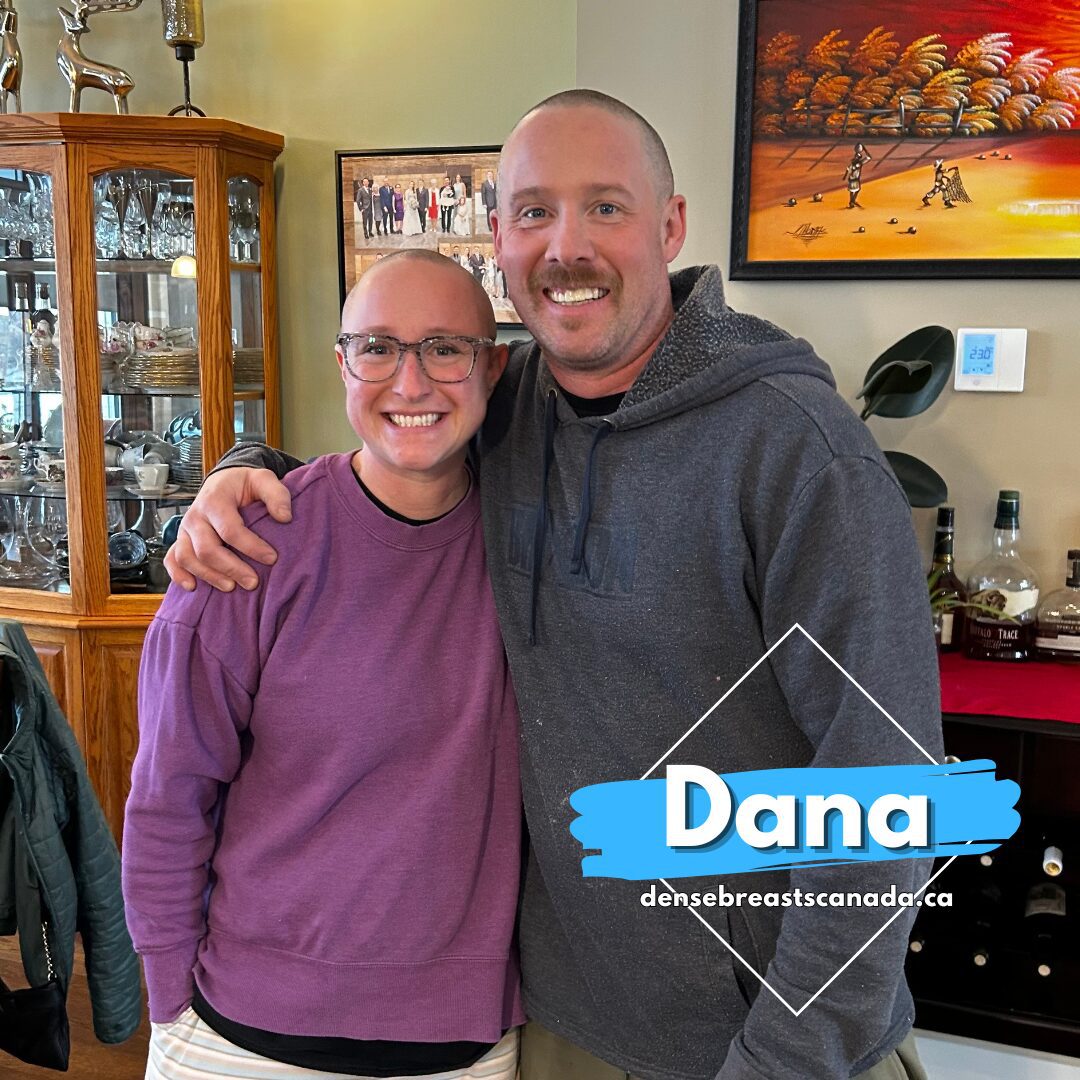
In April 2025, I started feeling different. At first, it was easy to explain away. I was gaining weight, feeling off, and experiencing symptoms that seemed consistent with perimenopause. I went to my doctor looking for answers, but I was reassured that this was simply part of getting older. Still, something didn’t feel right.
During one of those appointments, I asked for a mammogram. A requisition was submitted, and I was scheduled for June 2026—more than a year away.
Life carried on.
Then in October 2025, I noticed something unusual. I had a sore scab on my nipple that wouldn’t heal. It wasn’t dramatic, but it was persistent. Once again, I went back to my doctor.
Over the following weeks, I was prescribed cream after cream. The scab would improve slightly, but it never completely disappeared. As time went on, I began to feel like there was something brewing underneath the surface. I couldn’t explain it, but my instincts told me something wasn’t right.
I returned to my doctor and asked if my mammogram could be moved up. In November, I was referred to a dermatologist. I was prescribed another cream and told to return in a few weeks if the issue persisted.
Meanwhile, my mammogram was moved up to January 2026.
Then everything changed. On December 17, at age 42, I received a phone call I never expected. I was at work when the dermatologist called to tell me that my biopsy showed Paget’s Disease of the Nipple—a rare form of breast cancer.
You have cancer.
Those words hit me like a freight train. I remember sitting there in complete shock. I hadn’t gone into that day expecting life-changing news. Suddenly, I was being told I needed additional testing and referrals. I panicked. I called everyone I could think of, trying to get my mammogram moved up sooner.
Fortunately, a major snowstorm created a cancellation, and I was able to get in on December 19. I have never been so scared in my life as I was walking into that mammography appointment. The tears started before I even entered the room. The technologist could see my fear. So could the women sitting in the waiting room. There was an unspoken understanding among all of us. When I explained my diagnosis, the technologist was incredibly thorough. She did her best to reassure me, but I could tell she was concerned.
After the mammogram, I was sent directly for an ultrasound. I still remember every scan, every room, and every conversation. The staff were compassionate and supportive, but deep down, I knew this wasn’t going to be a simple story.
As I waited for answers, I became consumed with trying to understand what was happening. I checked my health records constantly. I researched every term I could find. I learned that I needed additional imaging, including an MRI and CT scan, but at times it felt like I was trying to navigate the system alone. The uncertainty was paralyzing. I knew I had cancer, but I didn’t know how much, how aggressive it was, or what came next.
Christmas arrived, but it barely felt like Christmas. I wasn’t sleeping. I wasn’t eating. I wasn’t present. I was simply waiting. Waiting for the Breast Health Clinic. Waiting for appointments. Waiting for answers. Waiting for my life to begin moving again.
Finally, I received a call for a biopsy appointment on January 15. By then, my nerves were completely shot. When I arrived at the clinic, I was overwhelmed. But then something incredible happened. A good friend of mine worked there and happened to be involved in my care. She stayed with me through the procedure, held my hand, and helped me through one of the most frightening moments of my life. That day, four samples were taken, including biopsies from suspicious areas and lymph nodes.
As an engineer, my natural instinct was to research and understand everything. What I quickly learned is that breast cancer isn’t just breast cancer. There are countless subtypes, grades, receptors, treatment plans, and outcomes. Before this experience, I had no idea. I learned more about cancer in a matter of weeks than I ever thought possible.
One lesson I learned very quickly was this: Don’t let Google become your doctor. Educate yourself, absolutely. Ask questions. Understand your diagnosis. But when fear takes over, call the clinic. Talk to the nurses. Talk to the experts. There are people who can help you understand what you’re facing without sending you into a spiral of worst-case scenarios.
Then came January 23. My husband and I walked into the surgeon’s office believing we had caught this early. Maybe Stage 1. Possibly Stage 2. We were preparing ourselves for surgery and a return to normal life. Instead, we heard words that changed everything. “You have Stage 3A breast cancer.”
The cancer involved a large area and had spread to a lymph node. Because of the extent of the disease, surgery would not come first. We would need chemotherapy to shrink the cancer before surgery could happen. I remember the shock. Not just mine, but my husband’s too. We had prepared ourselves for cancer. We had not prepared ourselves for Stage 3 cancer. The next several hours were spent calling family and sharing news we never imagined having to share.
On February 4, my husband and I walked into the Allan Blair Cancer Centre. I was terrified. The oncologist sat down and asked me a question I will never forget: “What do you know so far?”
As an engineer, I had spent weeks studying every report and scan. I rattled off terms I had practically memorized: HER2-positive. ER-negative. PR-negative. Invasive ductal carcinoma. Grade 2. Lymph node involvement. The doctor smiled and said, “Okay, you know a lot.”
For the next hour and a half, he and the oncology nurse patiently filled in the blanks. For the first time since December, I felt something I hadn’t felt in months. Hope.
They explained the treatment plan: Six rounds of chemotherapy every three weeks. Surgery. Additional treatment afterward. Most importantly, they told me something I desperately needed to hear: “We have treatment. We can do something about this.”
Suddenly, the panic began to ease. We had a plan. Now came another challenge I wasn’t prepared for. Telling people. One of the things I learned very quickly is that receiving a cancer diagnosis doesn’t automatically mean you’ve accepted it. I hadn’t.
I was still trying to process what was happening. I was still trying to understand what Stage 3A breast cancer meant for my future. I was still trying to navigate my own fear.
Yet suddenly I found myself in conversations where other people were looking to me for reassurance. As women, many of us are natural caregivers. We are the ones who help, support, organize, and take care of everyone else. That had always been me. I was the person people called when they needed help. I was the problem solver. I was the one checking in on others. Now the roles were reversed.
People would ask how I was doing, and I honestly didn’t know how to answer. They would tell me everything was going to be okay, but deep down, I wasn’t sure it would be. I often found myself trying to comfort other people about my diagnosis when I hadn’t even processed it myself. It was emotionally exhausting.
I appreciated every message, every phone call, and every offer of support, but I simply didn’t have the emotional capacity to manage everyone else’s reactions while trying to survive my own.
So, I leaned heavily on my closest friends. I asked them to help share the news when I couldn’t. I also gave them a very specific request: If people wanted to help, don’t ask me what I needed. Just decide and do something. Because the truth was, I had no idea what I needed. I was overwhelmed. I was scared. I was barely making it through each day. The well-intentioned phrase, “Let me know if you need anything,” often left me feeling guilty because I couldn’t even identify what that “anything” was.
My friends and family became my advocates and my protectors. They helped communicate with others and let people know that while I appreciated their concern, I wasn’t always in a place where I could respond or reassure them. I needed time to process my own emotions before helping others process theirs.
That support allowed me to focus on what mattered most: getting through treatment. With a plan in place, and a support system around me, I was ready to begin chemotherapy. On February 11, I began chemotherapy. I won’t pretend I wasn’t scared. The word “chemotherapy” carries a weight that is difficult to describe until you hear it applied to yourself. Could I still work? Would I lose my hair? How sick would I become? Would I still feel like me? On my first treatment day, I felt like a deer in headlights.
The nursing staff knew immediately it was my first time. My nurse was patient, kind, and understood exactly what I needed. When I’m nervous, I make jokes. Thankfully, she understood that too. By the second bag of medication, I was starting to relax. By the end of the day, I was chatting with other patients, joking with staff, and realizing that maybe—just maybe—I could do this.
Walking into the cancer clinic for my first session was nothing like the image I had in my mind. I had expected something heavy and grim—rows of visibly sick people struggling through treatment.
I was completely wrong. What I saw instead was strength everywhere. People laughing. People supporting each other. People sharing their stories. People living their lives between treatments. It became almost like a strange kind of community.
I’m naturally curious, so over my next several treatments, I found myself inquisitively learning from others—hearing their stories, their diagnoses, and their approaches to getting through it.
I also brought different friends and family members with me each time, and they all had the same realization: this wasn’t what they expected either. It wasn’t like the movies. It was human. It was real. And it was full of resilience.
Yes, I was still nervous each time I went in, knowing what my body would go through next. By the third treatment, I could predict the cycle:
Days 1–4: high energy from steroids, feeling “wired.” Days 5–10: crash—fatigue, neuropathy, metallic taste. Days 11–14: what I jokingly called my “rash face” days. Days 14–20: gradually feeling stronger and less tired. Day 21: it starts again—counting down each cycle: halfway, two left, one to go.
Each cycle, I learned more about how to manage symptoms with my care team, adjusting and adapting as I went. With the side effects of my treatment came another challenge I wasn’t fully prepared for. Losing my hair. For many people, hair is just hair. When you’re facing cancer, it can feel like so much more.
My hair began falling out shortly after my first treatment, and it was devastating. It was one of the first visible signs that I was no longer just someone with cancer—I looked like someone going through cancer treatment. I struggled with it more than I expected.
Then my twin brother did something I will never forget. Seeing how upset I was, he shaved his head before I had shaved mine. He walked up to me and simply said, “See? It’s only hair. It will grow back.” He will probably never fully understand how much that moment meant to me. It wasn’t about the hair. It was about not feeling alone. It was about someone stepping into one of the hardest moments of my life and saying, “I’m here with you.” That simple act gave me the courage to take control of the situation instead of waiting for it to happen to me.
As I jokingly told everyone, I didn’t want to wait until I looked like a “mole rat.” A few days later, my mother-in-law, who is a hairdresser and breast cancer survivor herself, came over to shave my head. She did it with incredible compassion and care while my brother sat beside me holding my hand the entire time. For the first time since we were babies, we actually looked like twins again.
What I expected to be one of the most traumatic moments of my cancer journey became something entirely different. It became a day filled with love. My family and friends rallied around me. They told me I looked beautiful. They told me I didn’t need a wig. They told me my head was perfectly symmetrical—something I never imagined hearing in my lifetime. Slowly, something shifted. The fear began to fade. My confidence began to return. I realized that my hair was never what made me who I am. I was still me. Cancer hadn’t taken that away.
So, I decided to lean into the experience. I bought myself some new glasses, embraced my new look, and stopped trying to hide from it. For the first time in months, I felt a sense of control. Cancer had changed many things, but it hadn’t changed who I was. And that realization was incredibly freeing.
The months that followed were difficult, but manageable. I was fortunate to have incredible support. A close friend, also a breast cancer survivor, gave me some advice that became my bible. Eat your protein. Get enough sleep. Exercise when you can, even when you don’t feel like it. And strangely enough—watermelon became my best friend (acid reflex and heart-burn cure). Their guidance helped me prepare for treatment in ways only fellow survivors can understand.
Beyond that, I was surrounded by extraordinary people. My husband became my rock, my researcher, my advocate, and the person who kept me grounded when fear threatened to take over. My family, friends, coworkers, and leaders rallied around me.
The staff at the Breast Health Clinic and Allan Blair Cancer Centre provided exceptional care every step of the way. The nurses, physicians, volunteers, and support teams treated me not as a diagnosis, but as a person. That made all the difference.
Today, I have completed chemotherapy and am preparing for surgery. My journey is not over. There are still challenges ahead. But cancer has taught me lessons I never expected to learn. Trust your instincts. Advocate for yourself. Ask questions. Accept help. And never underestimate the power of a strong support system.
Breast cancer changed my life, but it also showed me the incredible strength of the people around me and the resilience I never knew I had. I am still here. I am still fighting. And I am moving forward one step at a time.
Stay tuned for the rest of the story…..