
Dana
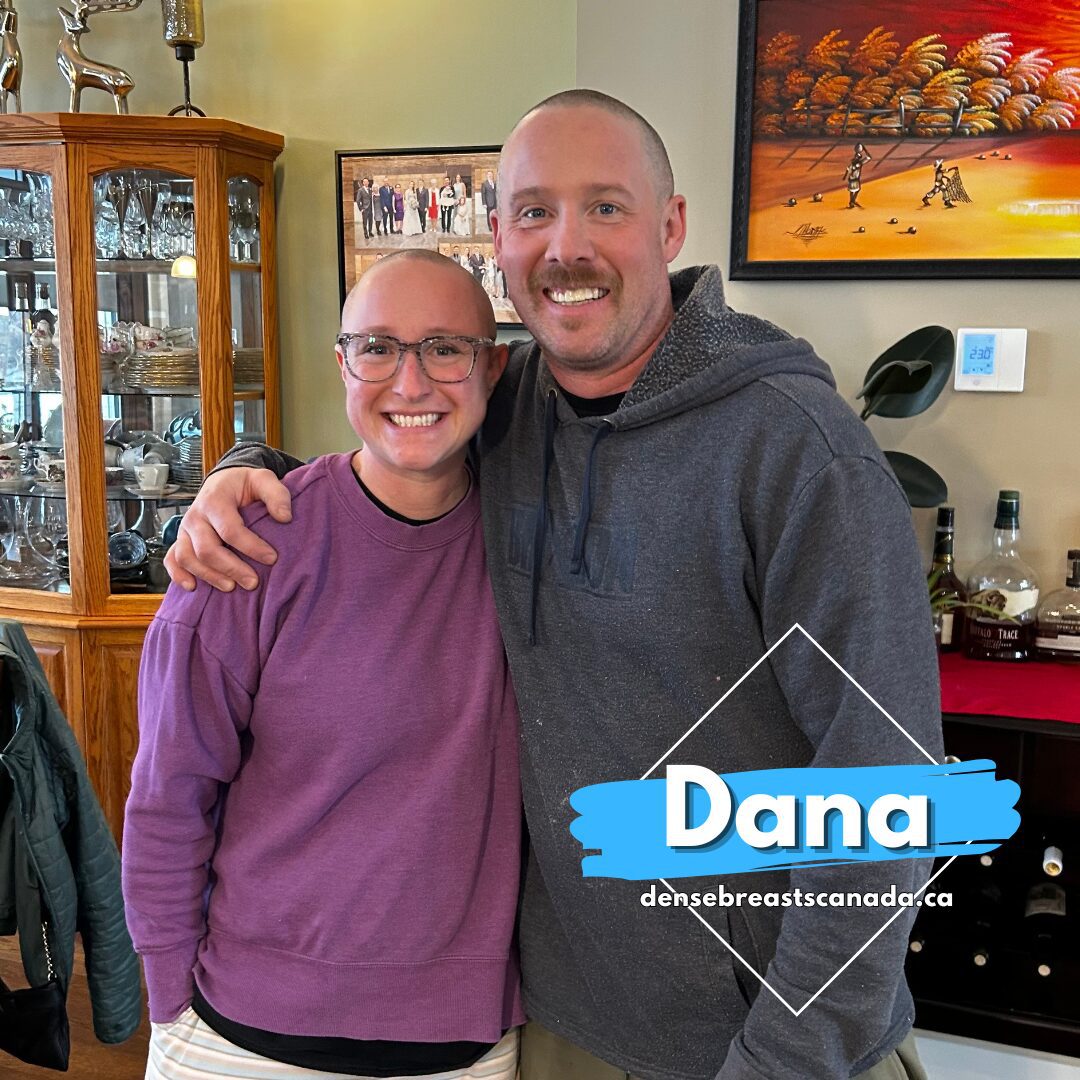
In April 2025, I started feeling different. At first, it was easy to explain away. I was gaining weight, feeling off, and experiencing symptoms that seemed consistent with perimenopause. I went to my doctor looking for answers, but I was reassured that this was simply part of getting older. Still, something didn’t feel right.
During one of those appointments, I asked for a mammogram. A requisition was submitted, and I was scheduled for June 2026—more than a year away.
Life carried on.
Then in October 2025, I noticed something unusual. I had a sore scab on my nipple that wouldn’t heal. It wasn’t dramatic, but it was persistent. Once again, I went back to my doctor.
Over the following weeks, I was prescribed cream after cream. The scab would improve slightly, but it never completely disappeared. As time went on, I began to feel like there was something brewing underneath the surface. I couldn’t explain it, but my instincts told me something wasn’t right.
I returned to my doctor and asked if my mammogram could be moved up. In November, I was referred to a dermatologist. I was prescribed another cream and told to return in a few weeks if the issue persisted.
Meanwhile, my mammogram was moved up to January 2026.
Then everything changed. On December 17, at age 42, I received a phone call I never expected. I was at work when the dermatologist called to tell me that my biopsy showed Paget’s Disease of the Nipple—a rare form of breast cancer.
You have cancer.
Those words hit me like a freight train. I remember sitting there in complete shock. I hadn’t gone into that day expecting life-changing news. Suddenly, I was being told I needed additional testing and referrals. I panicked. I called everyone I could think of, trying to get my mammogram moved up sooner.
Fortunately, a major snowstorm created a cancellation, and I was able to get in on December 19. I have never been so scared in my life as I was walking into that mammography appointment. The tears started before I even entered the room. The technologist could see my fear. So could the women sitting in the waiting room. There was an unspoken understanding among all of us. When I explained my diagnosis, the technologist was incredibly thorough. She did her best to reassure me, but I could tell she was concerned.
After the mammogram, I was sent directly for an ultrasound. I still remember every scan, every room, and every conversation. The staff were compassionate and supportive, but deep down, I knew this wasn’t going to be a simple story.
As I waited for answers, I became consumed with trying to understand what was happening. I checked my health records constantly. I researched every term I could find. I learned that I needed additional imaging, including an MRI and CT scan, but at times it felt like I was trying to navigate the system alone. The uncertainty was paralyzing. I knew I had cancer, but I didn’t know how much, how aggressive it was, or what came next.
Christmas arrived, but it barely felt like Christmas. I wasn’t sleeping. I wasn’t eating. I wasn’t present. I was simply waiting. Waiting for the Breast Health Clinic. Waiting for appointments. Waiting for answers. Waiting for my life to begin moving again.
Finally, I received a call for a biopsy appointment on January 15. By then, my nerves were completely shot. When I arrived at the clinic, I was overwhelmed. But then something incredible happened. A good friend of mine worked there and happened to be involved in my care. She stayed with me through the procedure, held my hand, and helped me through one of the most frightening moments of my life. That day, four samples were taken, including biopsies from suspicious areas and lymph nodes.
As an engineer, my natural instinct was to research and understand everything. What I quickly learned is that breast cancer isn’t just breast cancer. There are countless subtypes, grades, receptors, treatment plans, and outcomes. Before this experience, I had no idea. I learned more about cancer in a matter of weeks than I ever thought possible.
One lesson I learned very quickly was this: Don’t let Google become your doctor. Educate yourself, absolutely. Ask questions. Understand your diagnosis. But when fear takes over, call the clinic. Talk to the nurses. Talk to the experts. There are people who can help you understand what you’re facing without sending you into a spiral of worst-case scenarios.
Then came January 23. My husband and I walked into the surgeon’s office believing we had caught this early. Maybe Stage 1. Possibly Stage 2. We were preparing ourselves for surgery and a return to normal life. Instead, we heard words that changed everything. “You have Stage 3A breast cancer.”
The cancer involved a large area and had spread to a lymph node. Because of the extent of the disease, surgery would not come first. We would need chemotherapy to shrink the cancer before surgery could happen. I remember the shock. Not just mine, but my husband’s too. We had prepared ourselves for cancer. We had not prepared ourselves for Stage 3 cancer. The next several hours were spent calling family and sharing news we never imagined having to share.
On February 4, my husband and I walked into the Allan Blair Cancer Centre. I was terrified. The oncologist sat down and asked me a question I will never forget: “What do you know so far?”
As an engineer, I had spent weeks studying every report and scan. I rattled off terms I had practically memorized: HER2-positive. ER-negative. PR-negative. Invasive ductal carcinoma. Grade 2. Lymph node involvement. The doctor smiled and said, “Okay, you know a lot.”
For the next hour and a half, he and the oncology nurse patiently filled in the blanks. For the first time since December, I felt something I hadn’t felt in months. Hope.
They explained the treatment plan: Six rounds of chemotherapy every three weeks. Surgery. Additional treatment afterward. Most importantly, they told me something I desperately needed to hear: “We have treatment. We can do something about this.”
Suddenly, the panic began to ease. We had a plan. Now came another challenge I wasn’t prepared for. Telling people. One of the things I learned very quickly is that receiving a cancer diagnosis doesn’t automatically mean you’ve accepted it. I hadn’t.
I was still trying to process what was happening. I was still trying to understand what Stage 3A breast cancer meant for my future. I was still trying to navigate my own fear.
Yet suddenly I found myself in conversations where other people were looking to me for reassurance. As women, many of us are natural caregivers. We are the ones who help, support, organize, and take care of everyone else. That had always been me. I was the person people called when they needed help. I was the problem solver. I was the one checking in on others. Now the roles were reversed.
People would ask how I was doing, and I honestly didn’t know how to answer. They would tell me everything was going to be okay, but deep down, I wasn’t sure it would be. I often found myself trying to comfort other people about my diagnosis when I hadn’t even processed it myself. It was emotionally exhausting.
I appreciated every message, every phone call, and every offer of support, but I simply didn’t have the emotional capacity to manage everyone else’s reactions while trying to survive my own.
So, I leaned heavily on my closest friends. I asked them to help share the news when I couldn’t. I also gave them a very specific request: If people wanted to help, don’t ask me what I needed. Just decide and do something. Because the truth was, I had no idea what I needed. I was overwhelmed. I was scared. I was barely making it through each day. The well-intentioned phrase, “Let me know if you need anything,” often left me feeling guilty because I couldn’t even identify what that “anything” was.
My friends and family became my advocates and my protectors. They helped communicate with others and let people know that while I appreciated their concern, I wasn’t always in a place where I could respond or reassure them. I needed time to process my own emotions before helping others process theirs.
That support allowed me to focus on what mattered most: getting through treatment. With a plan in place, and a support system around me, I was ready to begin chemotherapy. On February 11, I began chemotherapy. I won’t pretend I wasn’t scared. The word “chemotherapy” carries a weight that is difficult to describe until you hear it applied to yourself. Could I still work? Would I lose my hair? How sick would I become? Would I still feel like me? On my first treatment day, I felt like a deer in headlights.
The nursing staff knew immediately it was my first time. My nurse was patient, kind, and understood exactly what I needed. When I’m nervous, I make jokes. Thankfully, she understood that too. By the second bag of medication, I was starting to relax. By the end of the day, I was chatting with other patients, joking with staff, and realizing that maybe—just maybe—I could do this.
Walking into the cancer clinic for my first session was nothing like the image I had in my mind. I had expected something heavy and grim—rows of visibly sick people struggling through treatment.
I was completely wrong. What I saw instead was strength everywhere. People laughing. People supporting each other. People sharing their stories. People living their lives between treatments. It became almost like a strange kind of community.
I’m naturally curious, so over my next several treatments, I found myself inquisitively learning from others—hearing their stories, their diagnoses, and their approaches to getting through it.
I also brought different friends and family members with me each time, and they all had the same realization: this wasn’t what they expected either. It wasn’t like the movies. It was human. It was real. And it was full of resilience.
Yes, I was still nervous each time I went in, knowing what my body would go through next. By the third treatment, I could predict the cycle:
Days 1–4: high energy from steroids, feeling “wired.” Days 5–10: crash—fatigue, neuropathy, metallic taste. Days 11–14: what I jokingly called my “rash face” days. Days 14–20: gradually feeling stronger and less tired. Day 21: it starts again—counting down each cycle: halfway, two left, one to go.
Each cycle, I learned more about how to manage symptoms with my care team, adjusting and adapting as I went. With the side effects of my treatment came another challenge I wasn’t fully prepared for. Losing my hair. For many people, hair is just hair. When you’re facing cancer, it can feel like so much more.
My hair began falling out shortly after my first treatment, and it was devastating. It was one of the first visible signs that I was no longer just someone with cancer—I looked like someone going through cancer treatment. I struggled with it more than I expected.
Then my twin brother did something I will never forget. Seeing how upset I was, he shaved his head before I had shaved mine. He walked up to me and simply said, “See? It’s only hair. It will grow back.” He will probably never fully understand how much that moment meant to me. It wasn’t about the hair. It was about not feeling alone. It was about someone stepping into one of the hardest moments of my life and saying, “I’m here with you.” That simple act gave me the courage to take control of the situation instead of waiting for it to happen to me.
As I jokingly told everyone, I didn’t want to wait until I looked like a “mole rat.” A few days later, my mother-in-law, who is a hairdresser and breast cancer survivor herself, came over to shave my head. She did it with incredible compassion and care while my brother sat beside me holding my hand the entire time. For the first time since we were babies, we actually looked like twins again.
What I expected to be one of the most traumatic moments of my cancer journey became something entirely different. It became a day filled with love. My family and friends rallied around me. They told me I looked beautiful. They told me I didn’t need a wig. They told me my head was perfectly symmetrical—something I never imagined hearing in my lifetime. Slowly, something shifted. The fear began to fade. My confidence began to return. I realized that my hair was never what made me who I am. I was still me. Cancer hadn’t taken that away.
So, I decided to lean into the experience. I bought myself some new glasses, embraced my new look, and stopped trying to hide from it. For the first time in months, I felt a sense of control. Cancer had changed many things, but it hadn’t changed who I was. And that realization was incredibly freeing.
The months that followed were difficult, but manageable. I was fortunate to have incredible support. A close friend, also a breast cancer survivor, gave me some advice that became my bible. Eat your protein. Get enough sleep. Exercise when you can, even when you don’t feel like it. And strangely enough—watermelon became my best friend (acid reflex and heart-burn cure). Their guidance helped me prepare for treatment in ways only fellow survivors can understand.
Beyond that, I was surrounded by extraordinary people. My husband became my rock, my researcher, my advocate, and the person who kept me grounded when fear threatened to take over. My family, friends, coworkers, and leaders rallied around me.
The staff at the Breast Health Clinic and Allan Blair Cancer Centre provided exceptional care every step of the way. The nurses, physicians, volunteers, and support teams treated me not as a diagnosis, but as a person. That made all the difference.
Today, I have completed chemotherapy and am preparing for surgery. My journey is not over. There are still challenges ahead. But cancer has taught me lessons I never expected to learn. Trust your instincts. Advocate for yourself. Ask questions. Accept help. And never underestimate the power of a strong support system.
Breast cancer changed my life, but it also showed me the incredible strength of the people around me and the resilience I never knew I had. I am still here. I am still fighting. And I am moving forward one step at a time.
Stay tuned for the rest of the story….. and here it is below……..
The Next Mountain
After my sixth and final chemotherapy treatment on May 28, I thought I had reached the finish line.
Instead, I realized I had simply reached the next mountain. Chemotherapy had been six cycles of showing up every three weeks, trusting the treatment, and learning how to live with the side effects. Surgery felt completely different. Now I had to decide what parts of me I was willing to let go.
From the day I finished chemotherapy until my appointment with my surgeon on June 4, my mind never stopped. Suddenly I was faced with decisions I never imagined I would have to make. Lumpectomy? Single mastectomy? Double mastectomy? Immediate reconstruction? Delayed reconstruction? Every option seemed to come with another list of risks, benefits, and unknowns.
For someone who makes decisions based on data for a living, this wasn’t a decision I could solve with a spreadsheet. It was my body. And there was no “right” answer.
Walking into the Breast Health Clinic on June 4, I was a strange mix of excitement, relief, anxiety, and fear. I had pages of questions ready. When my surgeon walked into the room, he surprised me. He remembered us. He remembered the shock on our faces in January when he had told us I had Stage 3A breast cancer.
This time was different. We were calmer. Not because cancer was any less scary, but because we had a plan and we knew the chemotherapy had done something. The scab that had started this entire journey was gone. The heaviness and hardness in my breast had disappeared. Physically, I knew things had changed. I just didn’t know if they had changed enough.
My surgeon smiled and said, “You’ve done a complete 180 since I last saw you.” Then he asked,”So Dana, what kind of surgery do we want to do?” I laughed. “I was actually hoping you would help me answer that.”
He carefully walked us through every option. A lumpectomy wasn’t recommended because of the size of the original cancer. That left a single mastectomy or a double mastectomy. Do you remove one? Do you remove both? How do you make that decision? There is always fear. What if it comes back? What if I choose wrong?
My surgeon never told me what to do. Instead, he helped me understand the risks and benefits of each option so I could make the decision that was right for me. That was exactly what I needed.
Losing a breast—or as I had started jokingly calling it, my “shitty titty”—felt strangely emotional. Would I still feel like myself? Would I recognize myself? Would I still feel feminine? Questions I never imagined asking suddenly became very real. Eventually, I signed the consent form for a right-sided mastectomy with lymph node removal. One signature. One decision. One chapter ending.
Then came another surprisingly emotional decision. Picking the surgery date. I chose July 7.
The timing allowed me to attend my cousin’s wedding before surgery. At the time it felt practical. Looking back, it became something more meaningful. It was my last chance to wear a dress with both of my breasts. A quiet goodbye that nobody else knew I was having.
I wore a beautiful black dress, proudly showed off my bald head, danced with my family, laughed, and for the first time since my diagnosis, I felt like myself again. That weekend was exactly what I needed before surgery. As July 7 approached, I realized I couldn’t control the surgery, the pathology, or the outcome. The only thing I could control was how I walked into that hospital.
A few days before surgery, I listened to a Mel Robbins podcast on mindset. I adopted several simple statements that became my anchor:
1. Today is going to be a great day.
2. Something cool is going to happen today.
3. Whatever happens today, I can handle it.
4. This is a new and exciting chapter in my life.
5. I need to give myself credit for the hard things I’ve already overcome.
6. I’m allowed to be a work in progress.
7. If I keep showing up, life will reward me.
8. I have something important to contribute to the world.
I repeated those words constantly.
And I made one promise to myself: Lead today with kindness. Thank every nurse. Thank every doctor. Thank every porter. Acknowledge every person helping me through one of the hardest days of my life.
Then came July 7.
Game day. I had never even had stitches before. Now I was voluntarily walking into a hospital to have my right breast removed. As always, humour became my coping mechanism. I messaged family and friends: “The gremlins have officially been served their eviction notice.””Say goodbye to my shitty titty.” Everyone laughed. Including me. At least on the outside. Inside, I was shaking.
The surgical team was incredible. Every nurse, physician, anesthesiologist, and staff member treated me with kindness and compassion. When I was wheeled into the operating room, I remember looking around and thinking one thing: The table is tiny. Seriously. Moments before major surgery, my biggest concern became: “What happens if someone is really big?” Everyone laughed. Apparently I was the only person worrying about operating table dimensions that day.
The next thing I knew, I was waking up in recovery. The surgery was over. I had done it. The first question I asked wasn’t about pain. It was about my lymph nodes. When the nurse told me only two had needed to be removed, I felt immediate relief.
The next twenty-four hours were filled with incredible care, endless kindness, and an unexpected number of Popsicles. Then came the surprises. Nobody warned me that the blue dye used in surgery could turn your urine bright green. And not just green. Grinch green.My husband and I were both slightly alarmed and completely entertained.
Then there was my brief panic when I learned I had received fentanyl during surgery. I was convinced I had somehow become a drug addict without realizing it. Thankfully, the nurses patiently explained how anesthesia actually works while my husband laughed at me. I suspect the staff encountered many nervous surgical patients. I’m not sure how many compared themselves to addicts and asked questions about hospital table dimensions.
Eventually, it was time to see my chest for the first time. The dressing came off. I looked down. It wasn’t frightening. It was simply different. There was a moment of silence as I processed what had changed.
Then I looked at my surgeon and asked: “So… high five?” He hesitated for a second. Then laughed and gave me one. Job well done.
Recovery brought its own surprises. The drain. The tightness. The physiotherapy. And perhaps strangest of all…Phantom nipple pain. Apparently your brain doesn’t immediately realize a body part is gone. Imagine having an itch you can’t scratch because there’s nothing there anymore. The first time it happened, I laughed. “My body clearly didn’t get the memo.”
When the drain finally came out, I was told it wouldn’t hurt. It would just feel weird. That turned out to be the most accurate medical explanation I’ve ever received. The only way I can describe it is like an alien slowly slithering out from under your skin. When the nurse offered to show it to me afterward, of course I said yes. Curiosity has gotten me this far. The moment I looked at it, I burst out laughing. It looked exactly like a miniature horizontal well completion. Apparently after surgery I had become my own tiny production facility. Only an engineer would find that comforting. But somehow I did.
As my body healed, a different challenge emerged. Waiting. Again. Waiting for the pathology report. Waiting to find out whether chemotherapy had completely destroyed the cancer. Then came the notification. Ding. You have new results available. My pathology report was ready. I stared at the notification for several minutes. Should I open it? My husband had repeatedly suggested maybe I should let him read it first. But curiosity won. The report was long. Very long. My heart was racing as I searched for the words that mattered. Then I saw them.”There is no evidence of disease.”I stared. Read it again. Then again. My gremlins had officially been evicted. The treatment had worked. I had achieved a complete pathological response. I immediately burst into tears and ran into my husband’s office. “What’s wrong?” he asked. “Nothing,” I said. “I think the report says the treatment worked. Can you make sure I’m reading this right?” A few minutes later he confirmed it. It said exactly what I thought it said. For the first time since December, I truly exhaled.
Three weeks later my surgeon confirmed the results. The smile on his face said everything before he even walked into the room. Soon afterward, my oncologist confirmed the same thing. “This is exactly what we hoped for.” The plan would be ongoing immunotherapy through the end of the year.
The remaining question was radiation. After extensive conversations with my healthcare team and many questions—because let’s be honest, “I have some questions” has become my catchphrase—we carefully reviewed the options. My case was unique. There wasn’t one obvious answer. There were simply informed choices. Ultimately, my husband and I made the decision we felt was best for my situation.
That experience reinforced one of the most important lessons cancer taught me. Ask questions. Understand your options. Trust your healthcare team. And never be afraid to advocate for yourself.
Looking back, cancer taught me more than I ever expected. It taught me to trust my instincts. Long before my diagnosis, I knew something wasn’t right. I didn’t know what it was. I couldn’t prove it. But I knew. It taught me that asking questions isn’t being difficult. It’s being informed.
My healthcare team never once made me feel silly for asking questions, and every answer gave me a little more confidence during a time that felt incredibly uncertain. It taught me how to accept help. For most of my life, I was the helper. Cancer forced me to become the person being helped.
That wasn’t always easy.
But it showed me how extraordinary people can be. My husband. My family. My friends. My coworkers. My healthcare team. Every single one of them helped carry me through this journey. Most importantly, cancer taught me that strength doesn’t mean you’re fearless. I was scared. A lot. Still am from time to time. Strength is showing up anyway. Strength is crying in waiting rooms. Strength is making impossible decisions. Strength is continuing to move forward when you don’t know what comes next.
If you are going through cancer right now, I want you to know that you are not alone. You don’t have to be brave every single day. You don’t have to have all the answers. Take it one appointment, one treatment, one scan, and one day at a time. And if you are supporting someone through cancer, please know that your presence matters more than your words.
Some of the most meaningful moments of my journey came from people who simply showed up. They sat beside me. Held my hand. Dropped off meals. Made me laugh. And reminded me that I wasn’t facing this alone.
Finally, if there is one thing I hope people take away from my story, it is this: Get screened. Know your body. Trust your instincts. Advocate for yourself.
As of July 2026, routine mammography screening became available starting at age 40. Please don’t wait. Earlier detection saves lives. I was diagnosed at 42 years old. What started as a small scab that wouldn’t heal turned out to be Stage 3A breast cancer.
Breast cancer doesn’t always look the way people expect it to. Sometimes the signs are subtle. Sometimes they are easy to dismiss. Pay attention. Ask questions. Get checked.
Today, I continue my treatment journey with gratitude, optimism, and a completely different perspective on life. Cancer changed me. But it doesn’t define me. I am stronger. More grateful. More present.
And significantly more knowledgeable about breasts, pathology reports, lymph nodes, phantom nipples, and the similarities between surgical drains and oilfield equipment. I’m still healing. I’m still learning. And I’m still moving forward. Just a one titty bitty. A whole lot more educated. And deeply aware that every day is a gift. The journey isn’t over.
But for the first time in a very long time, the road ahead looks bright.
And if sharing my story encourages even one person to get screened earlier, ask one more question, trust their instincts, or feel a little less alone, then every step of this journey has been worth sharing. ❤️