
Amie
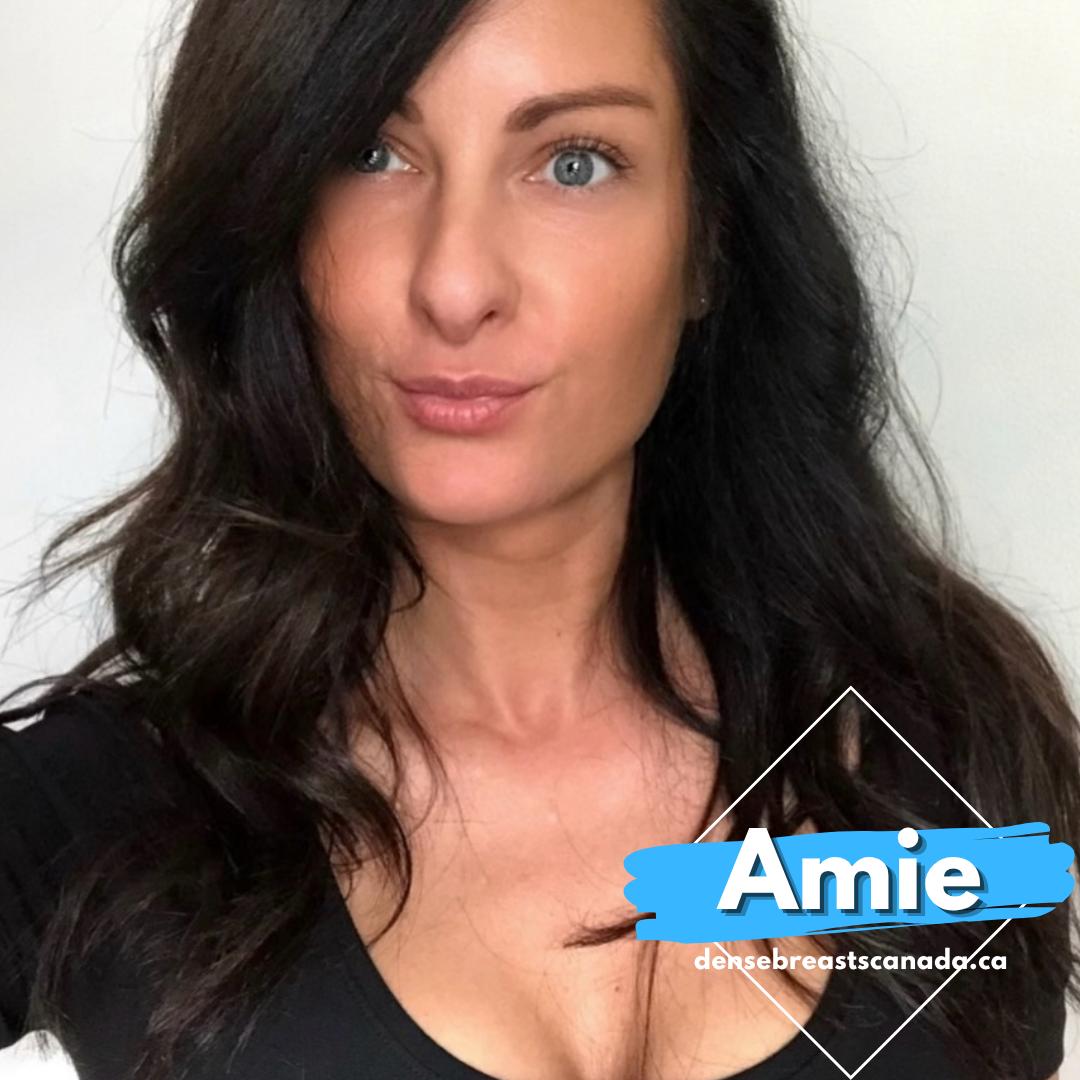
My name is Amie, and up to this point, I’ve been fairly reserved about my cancer journey.
Not because I’ve been hiding it. At times, it’s been quite visible. And not because I haven’t wanted to share. It’s simply what I’ve needed. That being said, throughout this journey, I’ve found a great deal of comfort in watching and learning from others who share their experiences on social media.
Along the way, I’ve also come across many informative, awareness-spreading organizations such as Dense Breasts Canada. Without resources like these, I don’t think I would have gained some of the knowledge I have today. I’ve also benefited from the support of people I know personally who have faced their own cancer diagnoses and generously shared their experiences.
The point is that, because of all of this, I’ve learned so much, felt significantly less alone, and found comfort during something incredibly scary. It has also helped greatly when desperately searching for answers to questions like, “Is what I’m experiencing normal?” or “Is anyone else going through this?” Reading others’ stories and scrolling through comment sections filled with people having similar experiences has been invaluable. It’s here that I’ve gained so much.
So, when Dense Breasts Canada asked if I would share my story, my answer was immediate.
I don’t know whether my story or words will help anyone or raise awareness. And if you’ve read this far, you’re probably thinking, “Get to the point already!” But I truly hope that if you choose to read on, it helps in some way, because so many other people’s stories have helped me. I’ll try to make a long story short.
You never think it’s going to be you. I think that’s a common sentiment. But it turned out it was me.
You also can’t fully comprehend the impact of hearing the words, “You have cancer,” until they’re directed at you.
Cancer has changed me in many ways. And as awful as it has been and can be, I’ve learned that for me, it hasn’t all been bad. I often say cancer saved me because it taught me so many positive things about myself and about life. It helped me understand what is truly worth prioritizing and what isn’t. It taught me to be more proactive about my health. I don’t stress nearly as much as I used to. Things that once
seemed important simply don’t anymore. The list goes on. That’s been my way of finding the positive amid all of this, and it has added tremendous value to my life.
My world was completely rocked hearing the words, “You have cancer.”
I was 45 years old, but my story actually began several years earlier. I had been experiencing breast tenderness and sore armpits. At first, I didn’t think much of it, but the symptoms weren’t going away. Eventually, my breasts became increasingly and painfully engorged. After several visits to my doctor’s office and a mammogram that showed nothing concerning, and because I wasn’t presenting with textbook or stereotypical symptoms, my symptoms were attributed to perimenopause, and I was prescribed progesterone.
However, the symptoms persisted. I continued voicing my concerns. I underwent more manual breast exams and was told things like:
“Breast cancer isn’t painful.”
“You just have a lot of cysts.”
“It would be more concerning if you had discharge.”
Still feeling that something wasn’t right, I insisted on another mammogram.
This was the mammogram that detected something.
Shortly afterward, I heard the words, “You have breast cancer.”
During the biopsies, imaging tests, and MRI that followed, I learned that I had dense breasts as well as multiple benign cysts. Sadly, I had never been formally informed or educated by a healthcare professional about what having dense breasts meant for me.
I was diagnosed with Ductal Carcinoma In Situ (DCIS), a very common type of breast cancer.
You learn so much throughout this process. One of the most shocking things I learned was that DCIS doesn’t always present as a lump or tumor.
What do you mean? That’s exactly what I had been watching for all along.
If there’s one thing I wish I had known before cancer, it’s that breast cancer awareness isn’t just about searching for lumps during self-exams. I wish I had been more informed about breast cancer and women’s health in general. I wish I had known that symptoms can vary and that statements like “breast cancer isn’t usually painful” don’t apply to everyone.
Women’s health is not one-size-fits-all.
If you’re experiencing abnormal symptoms or something feels off, pay attention to your body. Get it checked. Most importantly, trust yourself and advocate for yourself when something doesn’t feel right.
I’ve had many incredible doctors and healthcare professionals helping me along the way, but my journey has been far from easy or seamless. There have been multiple moments when I was left shaking my head in disbelief, shock, confusion, and still searching for answers. Fast forward to the day before my scheduled lumpectomy surgery.
I was having a seed placed in my breast to help identify the area requiring surgery. During the imaging process, everything suddenly stopped. I was asked to wait. After nearly half an hour with no explanation, a radiologist and their team finally came in and informed me there was another area that concerned them. My lumpectomy was cancelled. Instead, I was being scheduled for another MRI and yet another biopsy. Once again, I was in shock. What do you mean there might be more?
Why wasn’t this visible in earlier imaging?
The answer, once again: dense breasts.
Thankfully, those tests came back negative. However, my treatment plan changed, and I was scheduled for a full left-breast mastectomy with DIEP flap reconstruction. I waited four months for surgery, slightly longer than the preferred three-month window.
After surgery, I learned that my diagnosis had changed. I had Invasive Ductal Carcinoma, Stage 2, Grade 2, HER2-positive breast cancer, which is known to be fast-growing. It was also low estrogen-positive (1-9%), progesterone-negative, and had spread to three of the seven lymph nodes removed during surgery. Due to the location of the cancer, multiple rib bones also needed to be scraped.
My case was presented to the tumor board, and it was recommended that I undergo 16 weeks of chemotherapy consisting of eight rounds of AC (“the Red Devil”) and Paclitaxel, followed by one year of Herceptin immunotherapy infusions. I have also completed three weeks (15 rounds) of radiation treatment.
At this point in my journey, I still live with aches, pains, and various symptoms resulting from surgery, chemotherapy, radiation, and immunotherapy.
Everyone’s cancer journey and treatment experience is different, but some of the side effects have been wild. Nose hairs? Who knew how important those were until they were gone? Turns out they’re very important. Without them, your nose runs unexpectedly and can become painfully raw and sore. And medically induced menopause? Wow. No words could have fully prepared me for those hot flashes. Not to scare anyone because everyone’s experience is different, but I’ve found comfort in humor and in being able to relate to others who’ve experienced the same things.
I’m grateful to be here. I’m grateful for the medicine that continues to help me. And I’m grateful for the healthcare professionals who have cared for me.
I recognize that not everyone’s story looks like mine, and my experience is not meant to diminish anyone else’s. I deeply empathize with anyone who has been touched by cancer in any capacity.
There’s a saying: “Worst club, best members.” And it’s true.
Because now that I’m here, I’ve learned that cancer introduces you to some of the most supportive, helpful, and compassionate people you’ll ever meet. I’ve learned the importance of support and the incredible value of learning from others who understand.
We need to do better when it comes to education, awareness, and treatment surrounding women’s health. Better information and better care can be life-saving and life-changing.
I truly hope that happens. Thank you for taking the time to read my story.